
Article: 5,000 Years of Botanical Skincare: Oils, Hydrosols, and Butters

5,000 Years of Botanical Skincare: Oils, Hydrosols, and Butters
Long before skincare had a name, people were rubbing plants on their skin, pressing seeds for oil, simmering bark for resins, and distilling petals into fragrant water. The impulse to use what grows around us for beauty and care is one of the oldest threads in human history, and it runs from the earliest written records all the way to the face mist sitting on your bathroom shelf.
What keeps me coming back to this story is how consistent it actually stays. Civilizations separated by oceans and centuries kept landing on the same conclusions about what plants could do, that the right oil would protect skin from sun and wind, that flowers held in water released something the body recognized, that the fat pressed from certain seeds was something the skin happily drank in. Egyptian apothecaries and Persian distillers and Mapuche healers in the Andean foothills never compared notes, and they didn't need to, because the plants kept teaching everyone the same lessons.
From the first written beauty recipes all the way to the cold-pressed seed oils that joined the conversation only a few decades ago, the plants and the methods keep shifting, but the question underneath, what can a plant actually do for skin, has stayed the same for the better part of five thousand years.
Mesopotamia (c. 3000 BCE).
The Sumerians and Babylonians left us some of the earliest beauty recipes we have, and oils were so central to daily life that the Sumerian word for them (i₃) shows up in thousands of cuneiform tablets tracking who produced them, who received them, and in what quantities. People reached for these oils to anoint the body, scent the hair, and protect the skin from the dry, harsh climate, with castor oil (Ricinus communis), sesame oil (Sesamum indicum), and almond oil all in regular rotation, often blended with resins like myrrh (Commiphora myrrha) and aromatic spices into salves that worked as medicine and cosmetic at the same time.
Ancient Egypt (c. 1550 BCE onward).
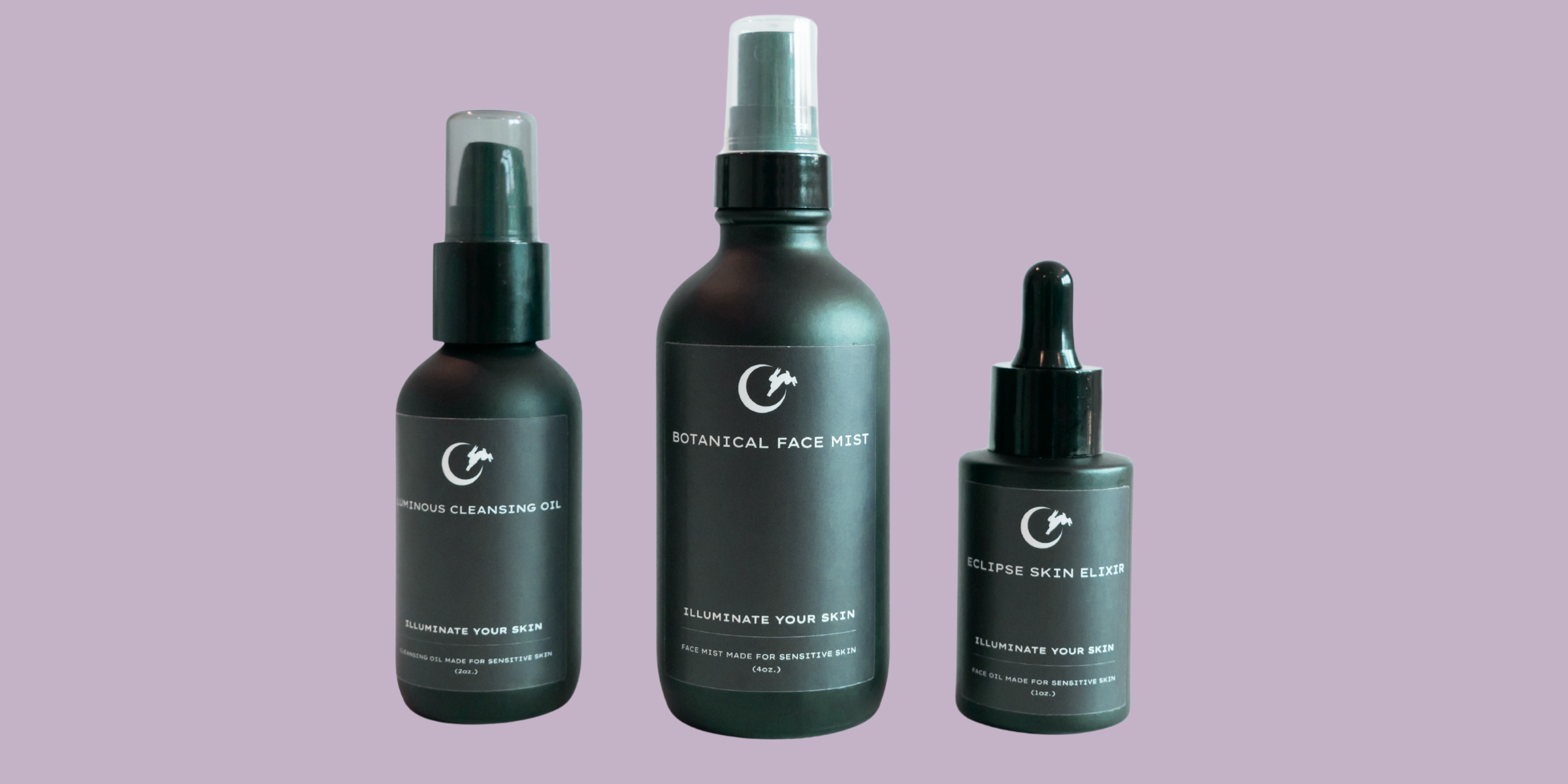
Egyptian beauty culture was sophisticated enough that whole papyri survive describing dozens of botanical preparations. The Ebers Papyrus (c. 1550 BCE) catalogued recipes built around castor oil, and Egyptian apothecaries also worked extensively with sesame oil, moringa oil (Moringa oleifera), almond oil, and balanos oil, all of them prized for keeping skin from drying out in the desert air. Rose petals and infused floral oils were luxury items mostly reserved for the wealthy, and modern face mists like Moonbunny's Botanical Face Mist actually sit in this same lineage, carrying floral preparations in water onto the skin much the way an Egyptian woman would have, splashing scented infusions on herself after a bath. Cleopatra's reputation as a beauty icon grew partly out of these traditions, with rose-scented baths, aloe applied to the skin, and daily anointing with oils that worked as much as medicine as they did as cosmetics.
Greece and Rome (c. 500 BCE–200 CE).
The word cosmetic itself comes from the Greek kosmetos, which simply means adornment. Olive oil (Olea europaea) became the everyday cleanser and moisturizer of the Mediterranean, scraped onto the skin with a tool called a strigil and rinsed off, and almond oil (Prunus dulcis) made its way into ointments around the same time. The Roman physician Galen put together an early "cold cream" from rosewater, olive oil, and beeswax, and the recipe turned out to be so durable that almond-based variations of it were still being made in European apothecaries nearly two thousand years later, with the basic structure of oil, wax, and water staying recognizable as a moisturizer to this day. Lavender (Lavandula spp.) takes its name from the Latin verb lavare, meaning "to wash," because Roman bathhouses scented their waters with it and Roman women rubbed lavender-infused oils into their skin after every bath.
The Islamic Golden Age (c. 800–1200 CE).
This is where hydrosols as we know them actually come into their own. Steam distillation had existed in cruder forms before this period, and Persian and Arab scholars are the ones who refined it into something precise. The polymath Ibn Sina, known in Europe as Avicenna, is widely credited with reworking the cooling coil of the alembic still and using it to distill Rosa damascena into both rose oil and rose water in the early eleventh century. The technology spread through trade and translation into medieval Europe, and Damask rose cultivation eventually became a centerpiece of agriculture in Persia, the Ottoman Empire, and what is now Bulgaria's Rose Valley, where it still defines whole regions of the landscape today.
Medieval and Renaissance Europe (c. 1100–1600 CE).
Through the medieval period, monastic gardens and physic gardens were the places where botanical knowledge actually got preserved and passed forward. The text De Ornatu Mulierum, attributed to the women physicians of Salerno around 1100 CE and circulated for centuries afterward, walked through close to a hundred plants used in beauty preparations, with detailed recipes for face washes, salves, and infusions. By the Renaissance, distilled herbal waters had become everyday luxuries, and Hungary Water (a rosemary-based tonic also called Queen of Hungary's Water) dates to around 1370 and was one of the first alcohol-based perfumes in Europe, used for centuries as both a fragrance and a skin tonic. Household manuals from this era carried recipes for rose tonics, lemon waters, and herbal salves, blending the practical and the ritual in much the same way Egyptian salves had thousands of years earlier.
Indigenous and Ayurvedic Oils.
While all of this was unfolding in Europe and the Mediterranean, parallel oil traditions were running for thousands of years in other parts of the world. Sesame oil has been the base of countless Ayurvedic skin and scalp preparations going back to some of the earliest written Ayurvedic texts we have, used both as a carrier for medicinal infusions and as the everyday massage oil that Ayurveda treats as inseparable from joint, skin, and nervous system care. And in the Andean foothills of southern Chile and Argentina, the Mapuche people used wild rose hip (Rosa rubiginosa and Rosa mosqueta) topically for wounds and scars for generations, a tradition that finally caught the attention of researchers at the University of Santiago in 1983 and brought rose hip seed oil into international beauty.
The Butters.
Plant butters have their own deep history, and most of the ones sitting in modern formulations come out of traditions that built around a single tree or fruit. Kokum butter (Garcinia indica) comes out of the Western Ghats of India, where Ayurvedic practitioners have been using it for centuries to soothe cracked skin, support wound healing, and treat the kind of stubborn dryness that responds best to a hard, slow-melting fat that warms on contact with the body. That same dense yet elegant texture is part of why kokum butter still appears in modern botanical body care, including products like Moonbunny’s Moonmelt Massage Balm, where it helps create a rich balm that melts gradually into the skin without feeling overly greasy. In the Amazon basin, Indigenous communities have been processing cupuaçu butter (Theobroma grandiflorum) for generations, working with the cousin of cacao for skin protection and hydration in a climate that needed a butter capable of absorbing fast and holding water inside the skin afterward, which is exactly the property that lets it sit at the heart of modern formulations like Moonbunny's Bakuchiol Glow Nectar, where the butter carries plant-derived actives into the skin without weighing the formula down. Cocoa butter (Theobroma cacao) belongs to that same family, and cacao itself was a sacred plant across Mesoamerica for over three thousand years, central to Olmec, Maya, and Aztec religious life and eventually carried into European cosmetics after the Spanish colonial period made the tree's oil-rich seeds globally available. And shea butter (Vitellaria paradoxa) has been hand-extracted in the West African savannah belt for nearly two thousand years, with archaeological evidence from what is now Burkina Faso showing continuous production going back to around 100 CE, and the butter traveled along medieval trade routes through Mali, Songhai, and Ghana as both a beauty product and a medicine before entering the European scientific record when the Scottish explorer Mungo Park documented its use in the late 1790s.
The Modern Cold-Press Era.
A handful of the oils on your shelf actually came along very recently. Grapeseed (Vitis vinifera), which Moonbunny uses in their Luminous Cleansing Oil, along with meadowfoam (Limnanthes alba), watermelon seed (Citrullus lanatus), strawberry seed (Fragaria spp.), and black currant seed (Ribes nigrum), all became cosmetic ingredients in the late twentieth century, when modern cold-press technology finally made it possible to extract oil from small seeds that older methods could not handle. These are the newest entries in a very old practice, and they fit right into the same impulse Mesopotamian apothecaries were acting on five thousand years ago.
What strikes me, looking across this whole timeline, is how little the underlying gesture has actually changed. The plants shift and the technology sharpens and the marketing language evolves, and through all of it the act of taking a piece of a plant, pressing it or distilling it or rendering it, and then offering it to your skin, has stayed one of the most consistent human practices we have on record.
Something about that feels steadying, because the face mist and the body oil and the rich butter sitting in your bathroom right now arrived with us long before they arrived with the wellness industry. The Damask rose in your hydrosol grew in the same fields that supplied Avicenna's still in eleventh-century Persia. The grapeseed oil in your cleanser belongs to the same family as the olive oil Roman women rubbed into their skin after bathing. The kokum and cupuaçu butters making their way through modern formulations were already part of skin care traditions in India and the Amazon when the rest of the world was still figuring out how to keep linen white.
Modern beauty often gets pitched as a recent invention, all new chemistry and new science, and while the chemistry actually is new, the plants themselves have been doing this work for thousands of years, long before anyone thought to write the recipes down.
— Agy | The Buffalo Herbalist
Agy is an herbalist with an MSc in Herbal Medicine and an MD (non-practicing), and a doctoral student in integrative health. Her work focuses on the intersection of traditional herbal medicine, whole-body wellness, and skin health.
Learn more at The Buffalo Herbalist
@thebuffaloherbalist
The Buffalo Herbalist Substack
References:
Baliga, M. S., Bhat, H. P., Pai, R. J., Boloor, R., & Palatty, P. L. (2011). The chemistry and medicinal uses of the underutilized Indian fruit tree Garcinia indica Choisy (kokum): A review. Food Research International, 44(7), 1790–1799. https://doi.org/10.1016/j.foodres.2011.01.064
Boskabady, M. H., Shafei, M. N., Saberi, Z., & Amini, S. (2011). Pharmacological effects of Rosa damascena. Iranian Journal of Basic Medical Sciences, 14(4), 295–307. https://doi.org/10.22038/ijbms.2011.5018
Civilyte, A., Karanikola, K., & Kramer, A. (2025). From antiquity to modern hygiene: the archaeological and medicinal legacy of lavender as a promising antimicrobial agent. GMS Hygiene and Infection Control, 20, Doc21. https://doi.org/10.3205/dgkh000550
Ebbell, B. (Trans.). (1937). The Papyrus Ebers: The Greatest Egyptian Medical Document. Oxford University Press.
Fleck, C. A., & Newman, M. (2014). Advanced skin care – A novel ingredient. Journal of the American College of Clinical Wound Specialists, 4(4), 92–94. https://doi.org/10.1016/j.jccw.2014.02.002
Gallagher, D. E., Dueppen, S. A., & Walsh, R. (2016). The archaeology of shea butter (Vitellaria paradoxa) in Burkina Faso, West Africa. Journal of Ethnobiology, 36(1), 150–171. https://doi.org/10.2993/0278-0771-36.1.150
Manniche, L. (1999). Sacred Luxuries: Fragrance, Aromatherapy, and Cosmetics in Ancient Egypt. Cornell University Press.
Nunn, J. F. (1996). Ancient Egyptian Medicine. University of Oklahoma Press.
Pisanti, S., Mencherini, T., Esposito, T., D'Amato, V., Re, T., Bifulco, M., & Aquino, R. P. (2023). The medieval skincare routine according to the formulations of Magistra Trotula and the Medical School of Salerno and its reflection on cosmetology of the third millennium. Journal of Cosmetic Dermatology, 22(2), 542–554. https://doi.org/10.1111/jocd.15234
Sallaberger, W., & Chambon, G. (Eds.). (2020–2023). i₃.MesopOil: Vegetable oils and animal fats in early urban societies of Syro-Mesopotamia [Digital data collection]. LMU Munich & EHESS Paris. https://www.i3-mesop-oil.gwi.uni-muenchen.de/
Pai Skincare. The history of rosehip oil in skincare. https://www.paiskincare.us/blogs/guides/history-of-rosehip-oil

Leave a comment
This site is protected by hCaptcha and the hCaptcha Privacy Policy and Terms of Service apply.